DSQC345E controller supports all the features you’ve
come to expect from the DeltaV system: self-addressing,
automatic I/O detection. All these features are designed
to make your projects execute faster — just plug and play!
Redundant Architecture罗克韦尔AB灵活的、的数字式伺服驱动器系列,可用于多种运动控制应用体系。宽范围的电源
DSQC236T 平台,连续性选项使得罗克韦尔AB的伺服驱动器成为多种机械控制体系(包括LOGIX,SLC)以及第三方
机械和运动控制系统具有吸引力的解决方案。
Fiber S300/400/500系列光纤光栅式温度传感器应用于不同结构表面或内部的温度测量,应用于隧道消防、开关柜测温、埋入式测温等,安装方式有表面安装、埋入等,被广泛应用在桥梁、大坝、海洋石油平台、输油输气管道等大型结构及建筑,以及电力、军工、消防、矿业、航空航天等领域大设备的测温。可以根据材料热膨胀系数提供对应灵敏度的传感器。
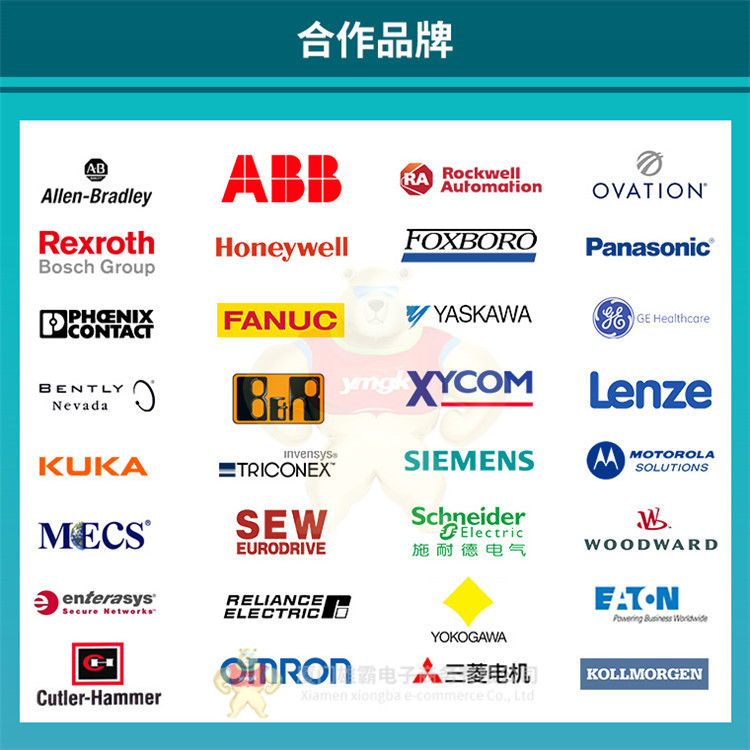
本特利,英维思,伍德沃德,福克斯波罗、西屋、瑞恩、
施耐德莫迪康、ABB、AB、西门子、摩托罗拉、GE发那科、
安川、博世、力士乐,ACSO,YOKOGAWA横河,力士乐
我们主要做DCS系统的配件,PLC系统的配件:本特利,英维思,伍德沃德,福克斯波罗、西屋、瑞恩、施耐德莫迪康、ABB、AB、西门子、摩托罗拉、GE发那科、安川、博世力士乐,ACSO,YOKOGAWA横河,力士乐等各大品牌的DCS系统配件,机器人系统配件,大型伺服系统备件
如何判断及维修电动机故障
电动机运行或故障时,可通过看、听、闻、摸四种方法来及时预防和排除故障,保证电动机的安全运行。
一、看
观察电动机运行过程中有无异常,其主要表现为以下几种情况。
1.定子绕组短路时,可能会看到电动机冒烟。
2.电动机严重过载或缺相运行时,转速会变慢且有较沉重的"嗡嗡"声。
3.电动机正常运行,但突然停止时,会看到接线松脱处冒火花;保险丝熔断或某部件被卡住等现象。
4.若电动机剧烈振动,则可能是传动装置被卡住或电动机固定不良、底脚螺栓松动等。
5.若电动机内接触点和连接处有变色、烧痕和烟迹等,则说明可能有局部过热、导体连接处接触不良或绕组烧毁等。
二、听
电动机正常运行时应发出均匀且较轻的"嗡嗡"声,无杂音和特别的声音。若发出噪声太大,包括电磁噪声、轴承杂音、通风噪声、机械摩擦声等,均可能是故障先兆或故障现象。
1. 对于电磁噪声,如果电动机发出忽高忽低且沉重的声音,则原因可能有以下几种。
(1)定子与转子间气隙不均匀,此时声音忽高忽低且高低音间隔时间不变,这是轴承磨损从而使定子与转子不同心所致。
(2)三相电流不平衡。这是三相绕组存在误接地、短路或接触不良等原因,若声音很沉闷则说明电动机严重过载或缺相运行。
(3)铁芯松动。电动机在运行中因振动而使铁芯固定螺栓松动造成铁芯硅钢片松动,发出噪声。
2.对于轴承杂音,应在电动机运行中经常监听。监听方法是:将螺丝刀一端顶住轴承安装部位,另一端贴近耳朵,便可听到轴承运转声。若轴承运转正常,其声音为连续而细小的"沙沙"声,不会有忽高忽低的变化及金属摩擦声。若出现以下几种声音则为不正常现象。

(1)轴承运转时有"吱吱"声,这是金属摩擦声,一般为轴承缺油所致,应拆开轴承加注适量润滑脂。
(2)若出现"唧哩"声,这是滚珠转动时发出的声音,一般为润滑脂干涸或缺油引起,可加注适量油脂。
(3)若出现"喀喀"声或"嘎吱"声,则为轴承内滚珠不规则运动而产生的声音,这是轴承内滚珠损坏或电动机长期不用,润滑脂干涸所致。
3.若传动机构和被传动机构发出连续而非忽高忽低的声音,可分以下几种情况处理。
(1)周期性"啪啪"声,为皮带接头不平滑引起。
(2)周期性"咚咚"声,为联轴器或皮带轮与轴间松动以及键或键槽磨损引起。
(3)不均匀的碰撞声,为风叶碰撞风扇罩引起。
三、闻
通过闻电动机的气味也能判断及预防故障。若发现有油漆味,说明电动机内部温度过高;若发现有很重的糊味或焦臭味,则可能是绝缘层被击穿或绕组已烧毁。
四、摸
摸电动机一些部位的温度也可判断故障原因。为确保安全,用手摸时应用手背去碰触电动机外壳、轴承周围部分,若发现温度异常,其原因可能有以下几种。
1.通风不良。如风扇脱落、通风道堵塞等。
2.过载。致使电流过大而使定子绕组过热。
3.定子绕组匝间短路或三相电流不平衡。
4.频繁启动或制动。
5.若轴承周围温度过高,则可能是轴承损坏或缺油所致
艾默生宣布推出iOps工作区解决方案,这种全新的操作员工作区可以减少人为错误,打造理想的操作环境。iOps解决方案将可视化硬件和软件与*技术操作台相结合,使操作员可以更快地与多个信息源交互,从而提高生产率和解决问题的能力。
iOps工作区解决方案——是艾默生与工作区供应商Barco、Vertiv和Evosite联合开发,通过将众多信息来源结合到一个虚拟工作区,在操作员界面进行信息集成。操作员只需登录一次,即可在一个工作区访问他们负责的有监测和控制区域。
“艾默生全新iOps工作区解决方案——具有可定制的用户界面,使操作员能够安全地控制和监测位于不同网络的多个信息源,”iOps工作区解决方案项目服务营销经理Todd Brase表示。“这为操作团队提供了一个通用的运营图,帮助他们更快地做出更明智的决策。”
全新的解决方案适用于各个工业,特别适用于石油天然气、炼油、石化和生命科学的操作,这些行业都需要一个中央控制室来管理多个过程区域,并能与其它大量企业应用实现交互。iOps工作区解决方案可管理规模可变的第三方软件应用程序、实时视频反馈以及艾默生的自动化软件和硬件,包括DeltaV分布控制系统。OpSpace是Barco操作员工作区软件,提供一目了然的体验,帮助控制室操作人员以更直观的方式工作。
Barco操作员体验副裁兼运营官Chris Sluys表示,“我们在开发OpSpace时,首先征集了现场操作员的反馈,以及他们描述的理想工作方式。随后,根据这些需求我们设计了近乎*的系统,它大大地改善了操作员的效率和成效,提高了决策质量。”
Vertiv和Evosite提供*的技术设备,适用于操作室和控制中心的24/7工作。*的设备为操作员提供了符合人体工程学的工作区,降低压力的同时提高工作效率。
Rockwell AB flexible, digital servo driver series can be used in a variety of motion control application systems. Wide range power supply
The platform and continuity option make the servo driver of Rockwell AB a variety of mechanical control systems (including LOGIX, SLC) and a third party
Attractive solutions for mechanical and motion control systems.
Fiber S300/400/500 series fiber bragg grating temperature sensors are used for temperature measurement on the surface or inside of different structures, tunnel fire protection, switch cabinet temperature measurement, buried temperature measurement, etc. The installation methods include surface installation, burial, etc. They are widely used in bridges, dams, offshore oil platforms, oil and gas pipelines and other large structures and buildings, as well as power, military, fire protection, mining Precise temperature measurement of large equipment in aerospace and other fields. The sensor with corresponding sensitivity can be provided according to the thermal expansion coefficient of the material.
Bentley, Invensys, Woodward, Foxboro, Westinghouse, Ryan
Schneider Modicon, ABB, AB, Siemens, Motorola, GE Fanuc
Yaskawa, Bosch, Rexroth, ACSO, YOKOGAWA Yokogawa, Rexroth
We mainly make DCS system accessories and PLC system accessories: DCS system accessories of Bentley, Invensys, Woodward, Foxboro, Westinghouse, Ryan, Schneider Modicon, ABB, AB, Siemens, Motorola, GE Fanuc, Anchuan, Bosch Rexroth, ACSO, YOKOGAWA Yokogawa, Rexroth and other major brands, robot system accessories, large servo system accessories
How to judge and repair motor faults
In case of motor operation or fault, four methods can be used to prevent and eliminate the fault in time to ensure the safe operation of the motor.
1、 Look
Observe whether there is any abnormality during the operation of the motor, which is mainly shown in the following situations.
1. Smoke may be seen from the motor when the stator winding is short circuited.
2. When the motor runs with serious overload or phase loss, the speed will slow down and there will be a heavy "buzz".
3. The motor operates normally, but when it stops suddenly, sparks will be seen at the loose connection; The fuse is blown or a component is stuck.
4. If the motor vibrates violently, it may be that the transmission device is stuck or the motor is poorly fixed, or the anchor bolt is loose.
5. If there is discoloration, burn mark and smoke trace at the internal contact and connection of the motor, it indicates that there may be local overheating, poor contact at the conductor connection or burnt winding.
2、 Listen
The motor shall make a uniform and light "buzz" sound during normal operation, without noise and special sound. If the noise is too large, including electromagnetic noise, bearing noise, ventilation noise, mechanical friction noise, etc., it may be a fault precursor or fault phenomenon.
1. For electromagnetic noise, if the motor makes a heavy noise, the reasons may be as follows.
(1) The air gap between the stator and the rotor is uneven. At this time, the sound varies from high to low and the interval between high and low sounds remains unchanged. This is caused by bearing wear, which makes the stator and rotor not concentric.
(2) The three-phase current is unbalanced. This is due to incorrect grounding, short circuit or poor contact of three-phase winding. If the sound is very dull, it indicates that the motor is seriously overloaded or operates without phase.
(3) The iron core is loose. During the operation of the motor, the fixing bolts of the iron core become loose due to vibration, which causes the looseness of the silicon steel sheet of the iron core and noise.
2. The bearing noise shall be monitored frequently during motor operation. Monitoring method: Hold one end of the screwdriver against the mounting part of the bearing, and close the other end to the ear to hear the running sound of the bearing. If the bearing operates normally, its sound is continuous and small "rustling" sound, and there will be no high and low changes and metal friction sound. The following sounds are abnormal.
(1) When the bearing is running, there is a "squeak" sound, which is caused by metal friction. It is generally caused by the lack of oil in the bearing. The bearing should be disassembled and added with proper amount of grease.
(2) If there is a "chirp" sound, it is the sound made by the ball when it rotates. It is generally caused by dry grease or lack of oil, and an appropriate amount of grease can be added.
(3) If there is a "clicking" or "creaking" sound, it is the sound generated by the irregular movement of the ball in the bearing, which is caused by the damage of the ball in the bearing or the long-term use of the motor, and the drying of the lubricating grease.
3. If the transmission mechanism and driven mechanism emit continuous sound instead of high and low sound, it can be handled in the following cases.
(1) Periodic "popping" sound is caused by the belt joint is not smooth.
(2) Periodic "thumping" sound is caused by looseness between coupling or pulley and shaft and wear of key or keyway.
(3) Uneven collision sound is caused by the fan blade colliding with the fan cover.
3、 Smell
The fault can also be judged and prevented by smelling the smell of the motor. If paint smell is found, it indicates that the internal temperature of the motor is too high; If a heavy paste or burnt smell is found, it may be that the insulation layer has been broken down or the winding has been burnt.



 微信二维码
微信二维码